


This month’s blog is about difficult versus toxic bosses, because understanding the difference could be the key to protecting your career and well-being. It is important to be able to identify and differentiate between them, because a difficult boss, when compared to a toxic boss, is actually manageable. You can learn to navigate them, and you can even end up staying and continuing to thrive in your career. But, if they're toxic, it’s not going to be sustainable.
This month’s blog is about difficult versus toxic bosses, because understanding the difference could be the key to protecting your career and well-being.
It is important to be able to identify and differentiate between them, because a difficult boss, when compared to a toxic boss, is actually manageable. You can learn to navigate them, and you can even end up staying and continuing to thrive in your career. But, if they're toxic, it’s not going to be sustainable.
Toxic bosses are brutally bad for your mental and physical health, and your career progression. Having worked with a lot of leaders over my 25-year career and seeing many managers struggle to become good leaders, I definitely know that there are a lot of difficult bosses out there. And we know from the research that the number one reason people leave their job is because of their boss, whether they are difficult or truly toxic (Gallup, 2008).¹
So, if you have a difficult boss, they’re frustrating to work with. There's no doubt about that. You might feel stressed, annoyed, or drained at times — but it’s not fundamentally damaging to your health. A toxic boss, in comparison, is damaging to your overall health. Your stress levels continue to grow, you're more likely to burn out, and have physical health impacts as a result, including high blood pressure, ulcers, and other diseases.
Another descriptor of a difficult boss is that they can be disorganised and inefficient, but you can still perform your job effectively. And I think we've all been there and worked for bosses like this. They mean well, but aren’t good with the details, and with organizing and planning.
Toxic bosses, in comparison, are much more intentional in their harmful behaviours, and they intentionally make your work/life more difficult. In contrast, with a difficult boss, you can learn how to navigate and work around their disorganisation. But you can’t with a toxic boss. This is well explained in Mary Abbajay’s book on Managing Up: How to Move Up, Win at Work, and Succeed with Any Type of Boss², where she provides key strategies for navigating difficult bosses.

Difficult bosses are poor communicators, so they may be hit and miss with remembering to share information, and are not the greatest at communicating in a clear, concise manner, whereas a toxic boss, on the other hand, communicates in a dishonest and manipulative way; you simply can’t trust them. What comes out of their mouth is not always true, and is often meant to cause harm.
In some cases, a difficult boss can be absent-minded and forgetful, but they’re not deliberately withholding information. In contrast, toxic bosses hoard information or selectively share with certain people. In fact, our recent research has found that toxic bosses are very good at causing divisions and distrust between teams and people (Pi & Hambely, 2025).³
You might also notice that a difficult boss may forget to show you appreciation at times. Although it may look different for different people, appreciation matters to most of us. Again, it's not coming from a place of harm, and they will not take credit for your work, whereas a toxic boss, on the other hand, does not show appreciation, and they'll take full credit behind your back.
Difficult bosses can sometimes micromanage and may have some perfectionistic tendencies and yes — it can be annoying — but you can still get your work done. Comparatively, a toxic boss has an excessive need to control, and you'll find extreme micromanagers in this category. These will absolutely thwart your productivity; they'll get in the way of your motivation and your ability to get work done, because the level of control and micromanagement is suffocating.

The biggest difference is that you can find ways to manage a difficult boss, and you cannot do so with a toxic boss. A toxic boss is really damaging to your engagement and your productivity. They are getting in the way of your career performance and growth. They harm your well-being, causing you stress, anxiety, affecting your physical health and sleep... and this gets worse over time. Use the following table to determine whether you might have a difficult or toxic boss:
Difficult vs Toxic Boss
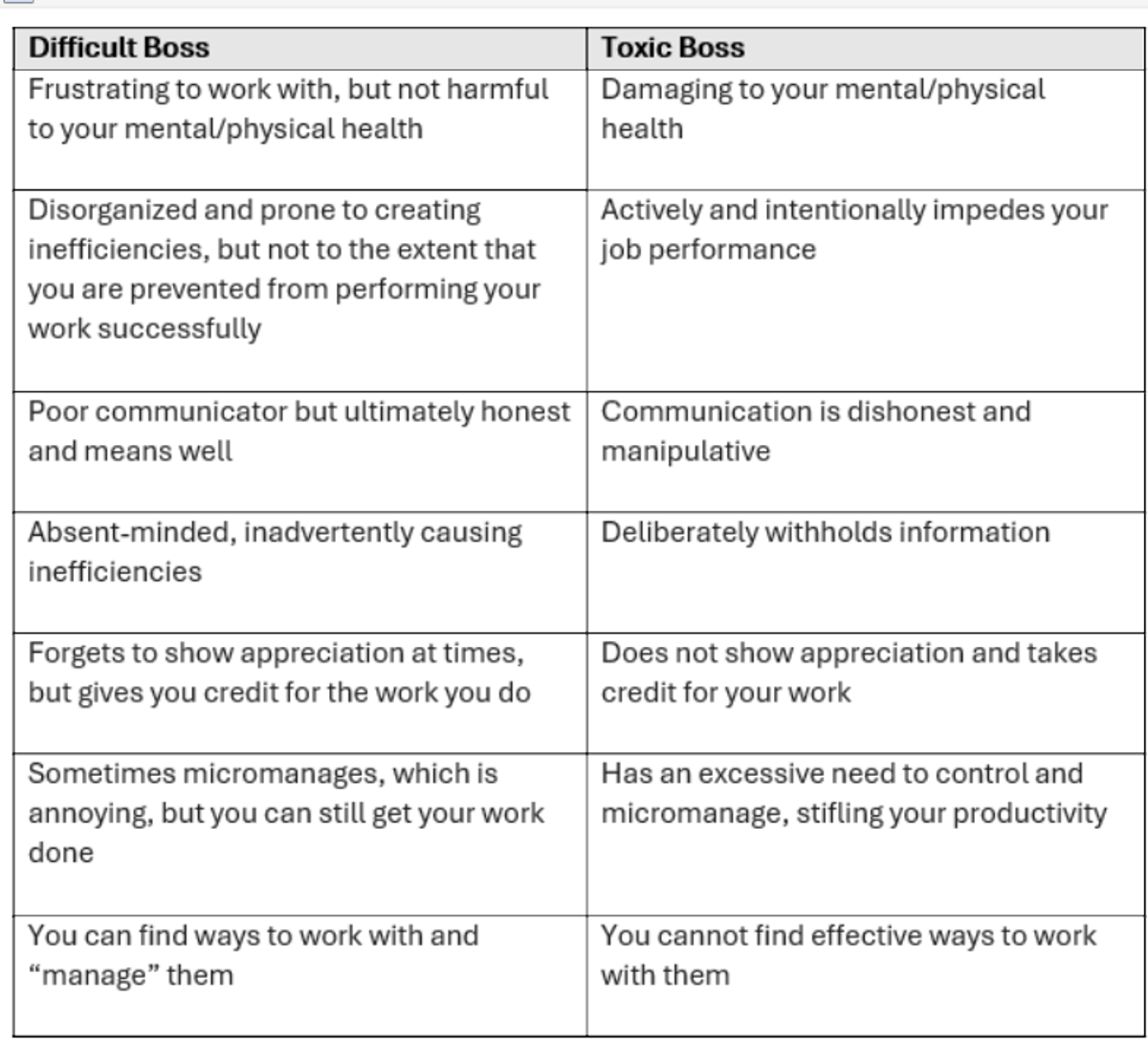
Note: Your boss does not need to demonstrate all the behaviors in each column to be a difficult or toxic boss. These are merely examples (though the more that apply in each column, the more likely your boss is either difficult or toxic, respectively). If your boss does not check any of the behaviors in the Toxic Boss column, you may still have a toxic boss, as these points are merely a sampling of the possibilities.
If your boss shows at least some characteristics of a toxic boss, it's important to start planning your exit. And you may feel that you're stuck there, right? You have a good salary, you have a pension and benefits - but there might be ways to maneuver and move within the organization. There may be other opportunities you haven't even thought of that are healthier workplaces out there. And until you start making an intentional plan, it's going to be difficult to imagine you can ever leave.
References:
- Robinson, J. (2008). Turning around your turnover problem. Gallup. https://news.gallup.com/businessjournal/106912/turning-around-your-turnover-problem.aspx
- Abbajay, M. (2018). Managing Up: How to Move Up, Win at Work, and Succeed with Any Type of Boss. Wiley.
- Pi, R., & Hambley, L. (2025). Unpublished manuscript.
YouTube: @dr.laurawhereworkmeetslife
Facebook: @Dr.Laura.whereworkmeetslife
Instagram: @dr.laura.live
Tik Tok: @drlaura.live
X: @drlauralive
Dr. Laura Hambley is a thought leader on Career and Workplace Psychology, passionate about career development. She founded Canada Career Counselling in 2009, however has specialized in career development since 1999 through her Master’s research and counselling in different settings, including outplacement and career transition firms in Alberta.
Dr. Laura learned early on that effective career planning enhances wellbeing, confidence, and clarity in one’s work and life. Combining the expertise of Psychology with Career Counselling is what she sought to do as she founded and evolved Canada Career Counselling from Calgary to Toronto, Victoria, and Halifax, providing Career Counselling and Career Coaching to thousands of clients over many years.
Dr. Laura enjoys her work as a Career Counsellor and Career Coach to professionals who are in mid- or senior stages of their career, helping them navigate complex career decisions and pivots. Her extensive experience as an Industrial/Organizational Psychologist, enables her to understand and address the challenges faced by individuals, leaders, teams, and organizational cultures. Having consulted to a wide range of organizations since the late 1990s, and becoming a future of work thought leader, has enabled her to help individuals and organizations navigate the latest trends impacting today’s organizations.
Dr. Laura fulfilled her dream of having her own podcast in 2020, called Where Work Meets Life™, where she interviews experts globally on topics around career fulfillment and thriving humans and organizations. She is a sought-after keynote speaker for organizations, associations, conferences, and events.
In addition to her Master’s in Counselling Psychology (1999), Laura holds a Ph.D. in Industrial/Organizational Psychology (2005) from the University of Calgary. She is a Registered Psychologist with the College of Alberta Psychologists, as well as a member of the Psychologists’ Association of Alberta and the Society of Human Resource Management (SHRM). She also contributes to teaching, supervision, and research as an Adjunct Professor of Psychology at the University of Calgary.
For more resources, look into Dr. Laura’s organizations: